The Lord of All Waters: Understanding the Ancient Deity Behind the Indian Navy’s Motto
Every time an Indian warship sets sail into the open ocean, it carries a thousands-year-old prayer on its hull. The official motto of the Indian Navy is “Sam No Varunah”, a Sanskrit phrase meaning “May the Lord of Water be auspicious unto us.” It serves as a modern prayer for safety, courage, and success during dangerous maritime operations. But who exactly is Varuna? Today he is known as the supreme lord of the waters but his story is actually much older, where he originally held a much significance before becoming the protector of the seas.
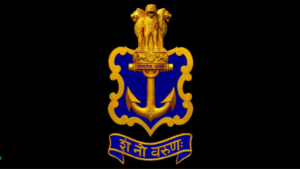
Motto of the indian navy.
“New Design of The PRESIDENT’S STANDARD AND COLOUR, and the INDIAN NAVY CREST Unveiled”, Press Information Bureau, 2022. https://www.pib.gov.in/Pressreleaseshare.aspx?PRID=1880977 accessed on June 23, 2026.
Varuna is one of the most revered deities in Hinduism. He is believed to be the son of Sage Kashyapa and originated from Aditi, the mother of Gods; he is also acknowledged as Aditya. He embodies both the cosmic and physical waters. Today, his expanse is not just across the boundless ocean but also terrestrial rivers giving him absolute sovereignty over all aquatic kingdoms. However, it was not always the same from the beginning.
————————-
- https://www.joinindiannavy.gov.in/en/about-us/maritime-heritage.html accessed on June 17,2026.
- Surabhi, “Lord Varuna – The Vedic God Of the Oceans”, Vedicfeed.
- R.C.Majumdar, The Vedic Age, Bhartiya Vidya Bhavan,Mumbai,1996, p.369.
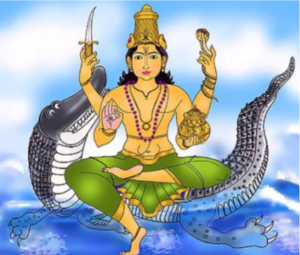
Lord Varuna
Sreenivasrao,“Varuna and his decline-Part three”, sreenivasrao’s blogs, 2012.
https://sreenivasaraos.com/2012/10/04/varuna-and-his-decline-part-three/ accessed on June 23, 2026.
During the Vedic times, Varuna was considered the supreme king of the cosmos. The ancient texts describe him as an all-seeing ruler who even employed a network of divine spies to ensure moral laws were followed. He was associated with Rta, the cosmic order that governs truth, law, and universal harmony being the guardian who kept the universe in balance. Alongside this role he also oversaw Apah, the cosmic waters that represent the source of all life.
But as time passed, a major shift occurred in the divine hierarchy, and Varuna was eventually replaced by Indra, the thunder god, as the king of the heavens. As authority shifted his role became focused entirely on the waters. In later Puranic traditions, this deep connection to the ocean led to him being referred to as the father of Lakshmi, the goddess of wealth, who emerged from the churning of the ocean.
Because water can be both life giving and incredibly dangerous, Varuna became a vital figure for ancient mariners. For sailors who frequently had to navigate treacherous waters without modern technology, Varuna’s presence offered spiritual assistance. Sailors would invoke him before a voyage, and there are countless Rigvedic hymns dedicated entirely to him.
Varuna is omnipresent and also shows up in India’s two biggest epics. In the Ramayana, Lord Rama needed to cross the waters to reach Lanka. He performed intense penance by the
————————-
- A.L.Basham, The Wonder that was India, Rupa.Co ,1967, p.236.Majumdar, The Vedic Age, pp.369-370.
- Devdutt Patnaik, “The Two Faces Of Varuna”, Devdutt, 2025.
- https://devdutt.com/the-two-faces-of-varuna/ accessed on June 17,2026.
- Adarsh Prajapati, “Varuna: The Vedic God of Cosmic Order and Waters”, Hinduvism, 2024.
- https://hinduvism.com/varuna-the-god-of-waters-and-cosmic-order-mythology/ accessed on June 17,2026.
shore to ask for a path. Varuna had emerged from the waves, showed his deep reverence, and advised Rama on how to build the Ram Setu so the army could cross safely. In the Mahabharata, Varuna acted as a divine contributor to the Pandavas. During the burning of the Khandava forest, he gifted the famous Gandiva bow to Arjuna, and also presented the powerful Kaumodaki mace and Sudarshan chakra to Lord Krishna which came to be known as their weapons.
————————-
Varuna’s influence has also connected different communities and cultures. Historians often draw parallels between him and Ahura Mazda, the supreme deity of ancient Zoroastrianism. Furthermore, his aquatic legacy took on a unique cultural form in the Sindhi community, where he is worshipped as Jhulelal, the deity of water, traveling, and protection.
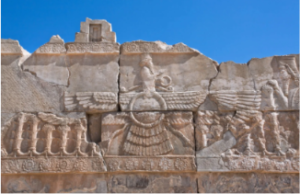
Ahura Mazda , https://www.britannica.com/topic/Ahura-Mazda accessed on June 23,2026.
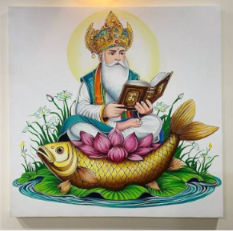
Lord Jhulelal, https://www.instagram.com/p/C_iS5Wpyu9N/ accessed from instagram on June 23,2026.
———————————————
- “God Varun Deva : The Hindu Lord Of Rains and Oceans”, Rudraksh Ratna.
- https://www.rudraksha-ratna.com/articles/lord-varuna?srsltid=AfmBOopcNX0S1SpOCQkkXxrDhUDxF2d1VHdfYaUzSAcYn5UMXKbviKaG accessed on June 17,2026.
- Basham, The Wonder that was India, p.236.
- Nikhil Chandwani, “Jhulelal’s secrets: What they didn’t tell you?”, The Times Of India, 2022.
- https://timesofindia.indiatimes.com/blogs/desires-of-a-modern-indian/jhulelals-secrets-what-they-didnt-tell-you/ accessed on June 17,2026.
Ultimately, Varuna is an incredibly important lord in Hinduism. While his absolute political supremacy among the gods declined over time, he remains the supreme lord of all the waters. Today, the connection between him and the Indian Navy is more than symbolic. His legacy has found its most powerful expression in the modern Indian Navy and is foundational to its identity and mission. By placing “Sam No Varunah” on their official crest, they successfully connect modern national security to these vedic roots ensuring that the ancient sovereign of the seas still keeps watch over the nation’s shores today. This is why the motto matters as a living declaration of purpose of the Navy’s mission to protect India’s waters.
– The Land of all waters by Intern Sansi Choudari
References
- Basham, A.L., The Wonder that was India, Rupa.Co ,1967.
- Chandwani, Nikhil, “Jhulelal’s secrets: What they didn’t tell you?”, The Times Of India, 2022.
- https://timesofindia.indiatimes.com/blogs/desires-of-a-modern-indian/jhulelals-secrets-what-they-didnt-tell-you/ accessed on June 17,2026.
- “God Varun Deva : The Hindu Lord Of Rains and Oceans”, Rudraksh Ratna.
- https://www.rudraksha-ratna.com/articles/lord-varuna?srsltid=AfmBOopcNX0S1SpOCQkkXxrDhUDxF2d1VHdfYaUzSAcYn5UMXKbviKaG accessed on June 17,2026.
- Majumdar,R.C., The Vedic Age, Bhartiya Vidya Bhavan,Mumbai, 1996.
- Patnaik, Devdutt, “The Two Faces Of Varuna”, Devdutt, 2025.
- https://devdutt.com/the-two-faces-of-varuna/ accessed on June 17,2026.
- Prajapati, Adarsh, “Varuna: The Vedic God of Cosmic Order and Waters”, Hinduvism, 2024. https://hinduvism.com/varuna-the-god-of-waters-and-cosmic-order-mythology/ accessed on June 17,2026.
- Surabhi, “Lord Varuna – The Vedic God Of the Oceans”, Vedicfeed.
- https://vedicfeed.com/lord-varun/ accessed on June 17,2026.


0 Comments