THE WADIA FAMILY: MASTER SHIPBUILDERS OF BOMBAY (18th – 19th Century)
The average age of a wooden vessel sailing on sea in the eighteenth and nineteenth centuries was taken to be 25-30 years. Once past that mark, maintaining the vessel was too costly, and voyaging in it became hazardous. But one vessel from Bombay proved such an assumption wrong. Today, the Royal Navy’s Leda class frigate HMS Trincomalee holds in its hull more than two hundred years of maritime history and is the oldest surviving British warship. What is remarkable and pertinent to us here is that apart from the ‘Grand Old Lady’ there were hundreds of ships that were built in the dockyards of Bombay by the famous Wadia shipbuilders, a dynasty of Parsis who were technically proficient and were the real creators of the ‘wooden walls’ of the British Empire.
BIRTH OF THE BOMBAY DOCKYARD
Naval Dockyard was founded in 1735 and the shipbuilding and repairs section was supervised by Lowjee Nusserwanjee Wadia. Prompted by the earlier scarcity of oak in Britain and the need to capitalize on developing trade routes, the East India Company brought Lowjee Nusserwanjee Wadia from Surat to take charge of ship building in Bombay in 1736. Much later on, it became clear how important this decision was as the Napoleonic wars resulted in a serious crisis of timber in Britain and led to dependence on teak ships, built by the Wadias, for the supremacy of the Royal Navy.
Lowjee along with his brother Sorabji constructed the first dry dock of Asia in 1750 making Bombay one of the leading trading ports for vessels from both West and East. It turned out to be a 150-year history of work of seven generations of Wadias who were Master Builders and constructed over 400 ships that sailed around the globe.
WHY WADIA SHIPS BECAME WORLD FAMOUS
The Wadia ships were known for their superior quality, which intimidated the English shipbuilders. These ships were famous because of the following three reasons:
Malabar Teak: Unlike English oak, which was difficult to come by in England because of the fast construction of ships, Wadia ships were constructed with teakwood. Because of the oil found in teakwood, the iron nails used to hold the wood in place did not corrode easily, and hence, even after many years, these ships still existed in a good condition because the teak is resistant to marine borers and lasts longer than its British counterpart.
Technical Engineering: Master builders such as Jamsetjee Bomanjee Wadia (1754-1821) played a similar part as modern-day Chief Naval Architects. Jamsetjee could always be seen carrying dividers and ship plans in his hands, heading a group of highly skilled craftspeople belonging to the Parsi community who were considered equal to European master-builders.
Cultural Tradition: As per Parsi Zoroastrian customs, Jamsetjee hammered an engraved silver nail in the keel of the ship before starting work on it, a practice thought to be essential for the prosperity of the ship.
VESSELS THAT SHAPED HISTORY
There are 22 ships which the Wadia family has created for the Royal Navy and each one is of historical importance and has traveled the world.
HMS Minden (1810): The first ship of the line built for the Royal Navy outside the United Kingdom. The poet Francis Scott Key has debatably written the American national anthem on board HMS Minden observing the bombardment of Fort McHenry in 1814.
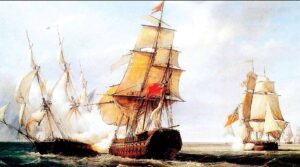
HMS Minden (1810)
HMS Cornwallis (1812): A veteran from the War of 1812, it later became the flagship in the First Opium War. On August 29, 1842, the Treaty of Nanking by which Hong Kong passed into the possession of the British Empire, was signed aboard this ship.
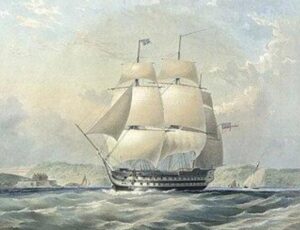
HMS Cornwallis (1812)
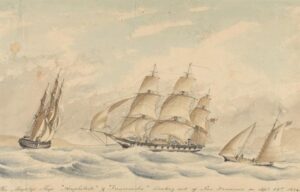
HMS Trincomalee (1817): Her construction began in May 1816 and cost £23,000. Launched on October 12, 1817, she sailed to the Portsmouth Dockyard at an extra cost of £6,600. Most post-Napoleonic ships have remained in standby reserve, but the career of HMS Trincomalee was enormous, including the policing the slave trade in West Indies, defending the British interests in Haiti and Cuba (1847), participation in the Pacific Squadron (1852), and involvement in the Crimean War (1854).
An old painting titled Her Majesty’s Ships Amphitrite & Trincomalee Beating out of San Francisco on Sept 23rd 1854 shows the world coverage of these teak ships.
After being a training ship for volunteer youth between 1860 and 1897, she was rescued from scrapping by G Wheatley Cobb and was renamed TS Foudroyant and was utilized for adventure training till 1986. After undergoing major restorations that began in 1990, she is now a complete subsidiary of the National Museum of the Royal Navy based in Hartlepool. Just recently, around 2015, her original 1817 carved teak figurehead, ‘the Turbaned Man’, was installed on her mast for more than 55,000 pounds.
LEGACY: FROM TIMBER TO MODERN STEEL
The official rule of the Wadia family at the dockyard ceased in 1913 ². However, the legacy they left spans between the period of wooden clippers and contemporary steamers. When steel began dominating during the Industrial Revolution, the dockyard had changed from a place for building ships to repairing them in 1884.
The current Mumbai Naval Dockyard occupies an area of 138 acres and encompasses several heritage buildings including Bombay Castle. Right at the entrance of the dockyard is the Statue of the Unknown Worker that honors thousands of workers who, under the guidance of the Wadia family, constructed an empire on the sea. Indeed, ships such as the HMS Trincomalee belong to the core collection of the National Register of the Historic Vessels of UK.
Reference:
GlobalSecurity.org. “Bombay Dockyard / Naval Dockyard, Mumbai.” GlobalSecurity.org, Bombay Dockyard / Naval Dockyard, Mumbai. Accessed 7 July 2026.
GlobalSecurity.org. “The Evolution and Heritage of the Mumbai Naval Dockyard.” GlobalSecurity.org, Bombay Dockyard / Naval Dockyard, Mumbai. Accessed 7 July 2026.
Hand, H. “Her Majesty’s Ships Amphitrite & Trincomalee Beating out of San Francisco on Sept. 23rd, 1854.” Royal Museums Greenwich, Her Majesty’s Ships Amphitrite & Trincomalee Beating out of San Francisco on Sepr 23rd 1854 | Royal Museums Greenwich. Accessed 7 July 2026.
Marathe, Yeshwant. “HMS Trincomalee: A Living Prowess of Shipbuilding.” Maritime History Society, HMS TRINCOMALEE: A LIVING PROWESS OF SHIPBUILDING | Maritime History Society (MHS India). Accessed 7 July 2026.
Marathe, Yeshwant. “The Wadia Master Builders and the Legacy of Bombay Shipbuilding.” Maritime History Society, Master Builder – History Cafe. Accessed 7 July 2026.
“The Bombay Dockyard in the Early Nineteenth Century.” Quarterdeck, no. 1, Spring 2010, pp. 8–10, Accessed 7 July 2026.
“What Ties The Star-Spangled Banner to Bombay’s Dockyard.” The Times of India, What ties The Star-Spangled Banner to Bombay’s dockyard | Mumbai News – Times of India. Accessed 7 July 2026.


0 Comments